
Last updated: July 2026
In Summary
- An Assurance Vie and a UK investment account can often hold similar underlying investments, but they are treated very differently under French law.
- Tax treatment is only one part of the picture. Succession planning and long-term flexibility are equally important considerations.
- An Assurance Vie is not automatically the right answer, and retaining UK structures remains appropriate for many British expatriates.
- The question is rarely about the investments themselves. It is about the wrapper in which those investments are held, and how France treats that wrapper.
- The most suitable approach depends on your objectives, time horizon, and wider personal and financial circumstances.
For many British expatriates living in France, one of the most common financial questions is whether they should continue holding UK investment accounts or whether an Assurance Vie would provide a more appropriate structure. It is a reasonable question, and one where misconceptions are common.
Many people assume the debate is about investment performance. In reality, the underlying investments inside both structures can often be very similar. What differs is the way France treats the wrapper itself, and that distinction can become increasingly significant the longer someone remains French tax resident.
This article explains the key differences, the considerations that matter most, and the questions worth asking before making any decisions.
Why The Wrapper Matters More Than The Investments
Once you become a French tax resident, the structure holding your assets becomes as important as the assets themselves.
Two people can hold virtually identical portfolios, global equity funds, bonds, income-generating investments, diversified strategies, and experience meaningfully different outcomes from a taxation and succession perspective simply because those assets are held in different wrappers. This is one of the reasons why British expatriates who have been living in France for some time often begin to think about structure rather than investment performance alone.
Understanding the difference between the two wrappers is the starting point for making an informed decision.
Keeping a UK Investment Account
Many British expatriates arrive in France with existing UK investment accounts that have been built over many years. The arrangements are familiar, administration is straightforward, and there may be no obvious reason to make immediate changes. For some people, maintaining those structures remains entirely sensible.
However, once you become French tax resident, France generally treats a UK investment account as an ordinary investment account. Income, dividends, interest, and realised gains may create taxable events under French rules as they arise. Portfolio changes can also trigger tax consequences. The fact that the account originated in the UK does not give it any special status or treatment under French law.
That does not make a UK investment account unsuitable. It simply means that it needs to be viewed through a French tax lens rather than a UK one, and that the implications of holding it as a French resident need to be understood and factored into the overall planning picture.
There is also a reporting dimension. French tax residents are required to declare overseas financial accounts and investments, and the requirements are specific. This is an area where errors are common and the consequences of non-compliance can be material.
How an Assurance Vie is Different
An Assurance Vie is frequently misunderstood. It is not an investment. It is a tax-efficient insurance wrapper that is recognised under French law, and within that wrapper investors can hold a broad range of underlying investments including global equity funds, bond funds, cash funds, and diversified portfolios.
One of the distinguishing features of the structure is that switching investments within the policy does not generally create an immediate taxable event. Tax is normally deferred until withdrawals are made, which provides greater flexibility when portfolios need to evolve over time without triggering tax on every change.
For long-term investors in France, this characteristic is one of the reasons the Assurance Vie has become such a widely used planning vehicle. It is not a product designed exclusively for the wealthy or for complex situations. It is one of the most common long-term investment structures used by French residents generally, and it has specific features that are particularly relevant for British expatriates with cross-border planning needs.
The Wealth Genesis | What Is An Assurance Vie? A Guide for British Expats in France
Tax Treatment
Tax is often the first consideration, but it should not be the only one.
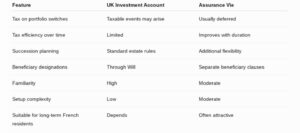
With a UK investment account held by a French tax resident, dividends, interest, and realised gains can create taxable events in France as they arise. Each transaction or income distribution may need to be reported and assessed under French rules, and the interaction with the UK tax position, including any UK tax already paid, adds further complexity.
An Assurance Vie operates differently. Growth inside the policy generally accumulates without immediate taxation, and tax is normally only assessed when withdrawals are made. After certain holding periods, the tax treatment on withdrawals becomes progressively more favourable, which is one of the reasons the structure is viewed as a long-term planning vehicle rather than simply an alternative to a standard investment account.
The longer the investment horizon, the more material these differences tend to become. For someone who has recently moved to France and expects to remain there for many years, the cumulative difference in tax treatment can be significant. For someone with a shorter time horizon or different objectives, the picture may look different.
Succession Planning
One of the most important distinctions between the two structures relates to succession, and it is the one that is most frequently overlooked.
A UK investment account will generally form part of the estate and pass under the rules governing inheritance, which for a French resident involves French succession law. France operates a forced heirship system that differs substantially from English law, and the interaction between an English will, French succession rules, and UK-held assets creates a planning dimension that requires careful consideration.
An Assurance Vie provides additional flexibility because beneficiary designations sit outside the will itself. This creates planning opportunities that are specific to French law and can be particularly valuable for blended families, couples with assets across multiple countries, and individuals who wish to have greater control over how their estate is distributed. The way those designations are structured matters significantly, and this is an area where specialist input is important.
For long-term French residents, the succession dimension of the Assurance Vie is often as important as the tax treatment, and in some cases more so.
Flexibility and Administration
Maintaining an existing UK investment account involves relatively little change in administration, which is one of its practical advantages. The arrangement is familiar, and for British expatriates who have recently moved to France, simplicity has genuine value.
Establishing an Assurance Vie involves more initial work. Assets need to be restructured, decisions need to be made about the policy structure and beneficiary designations, and the setup process takes time. For some investors, the planning advantages that follow are worth that initial effort. For others, simplicity and familiarity are the priority, at least in the near term.
Neither approach is inherently right or wrong. The answer depends on individual circumstances, objectives, time horizons, and the degree to which tax efficiency and succession planning are priorities.
Cost Is Often Overlooked
Tax efficiency and succession planning are important, but they are not the only considerations.
Charges matter as well.
An inefficient investment structure can be improved through planning, but excessive costs can permanently reduce long-term returns. This is one reason why the underlying investments and fee structure deserve as much attention as the wrapper itself.
The objective is not simply to move assets into an Assurance Vie. It is to ensure that the overall structure remains both efficient and cost-effective.
Does Every British Expatriate in France Need an Assurance Vie?
No, and this is one of the most common misconceptions in this area.
Moving to France does not automatically mean that everything should be restructured into an Assurance Vie. There are many situations where retaining UK structures remains entirely appropriate, either in full or alongside French structures. There are also situations where a combination of UK assets and an Assurance Vie produces the most practical and efficient overall solution.
The objective is never to force assets into a particular wrapper. The objective is to create a structure that works for your specific circumstances, your time horizon, your succession wishes, and your tax position. Simple solutions that achieve those objectives are often preferable to more complex arrangements that offer marginal additional benefit.
Questions To Ask Before Making Any Changes
Before making any decisions about investment structure, these questions are worth working through carefully.
How long do you expect to remain resident in France? The longer the time horizon, the more relevant the tax deferral characteristics of an Assurance Vie become.
Are you likely to need withdrawals in the short-term? If so, the holding period advantages of an Assurance Vie may be less immediately relevant.
How important is succession planning to you? If passing assets to specific beneficiaries in a controlled way is a priority, the succession features of an Assurance Vie deserve serious consideration.
Does your existing UK arrangement still function effectively from a French tax perspective? Understanding the current position is the necessary starting point before deciding whether any change is warranted.
Would restructuring create unnecessary complexity or cost? Simplicity has value, and any change should be assessed against the practical benefits it delivers.
These questions usually matter more than trying to identify which structure is objectively better in the abstract.
When Specialist Advice May Help
At The Wealth Genesis, we work with British expatriates in France whose financial affairs span both the UK and France. Many of our clients arrive with UK investment accounts, ISAs, pensions, and other assets that were established before they moved abroad. Effective planning requires those structures to be considered alongside French taxation and French succession rules rather than in isolation.
We work alongside French tax specialists where appropriate, and our advice is provided on a transparent, flat fee basis with no product commissions.
If you are uncertain whether your existing arrangements remain suitable for your situation as a French resident, or whether an Assurance Vie should form part of your longer-term planning, we are happy to discuss your circumstances and explain the options available.
Frequently Asked Questions
Should I transfer my UK investment account into an Assurance Vie?
Not automatically. Whether restructuring is appropriate depends on factors such as tax residency, time horizon, withdrawal requirements, succession objectives and the costs involved. In many cases, a combination of UK structures and an Assurance Vie provides the most practical solution.
Do I need to move all my investments into an Assurance Vie after moving to France?
No. Many British expatriates in France retain a combination of UK assets and French structures. The objective is to create an arrangement that works for your circumstances, not to restructure everything into a single wrapper regardless of whether that is appropriate.
Can an Assurance Vie hold the same investments as a UK account?
In many cases, yes. The underlying investments within an Assurance Vie can include global equity funds, bond funds, cash funds, and diversified strategies that are broadly comparable to those available within a UK investment account. The difference lies primarily in how France treats the wrapper rather than in the investments themselves.
Should I close my UK investment account after moving to France?
Not automatically. Existing UK investment accounts can continue to play a role within an overall cross-border strategy. The question is whether the current structure remains appropriate when viewed through a French tax lens, and that depends on your specific situation. Taking advice before making any changes is important.
How does an Assurance Vie work for succession planning in France?
An Assurance Vie allows you to designate beneficiaries outside your will, which provides planning flexibility that sits outside the standard French succession rules. This can be particularly valuable for blended families, couples with assets in multiple countries, and individuals who want greater control over how their estate is distributed. The way beneficiary designations are structured matters significantly and requires specialist input.
Is an Assurance Vie only suitable for large investment portfolios?
No. Although it is widely used by affluent individuals, the Assurance Vie is one of the most common long-term investment structures used by French residents generally. The planning advantages it offers are relevant across a broad range of portfolio sizes, though the most significant benefits tend to emerge over longer time horizons.
What is a Luxembourg Assurance Vie and is it different from a French one?
A Luxembourg Assurance Vie is a policy issued by a Luxembourg-regulated insurer rather than a French one. It can offer certain structural advantages, including a broader range of available investments and additional regulatory protections under Luxembourg law. Both types are recognised under French tax law and can be appropriate for French residents, depending on circumstances. Which is more suitable depends on the individual’s situation and objectives.
About The Wealth Genesis
The Wealth Genesis is a cross-border financial planning firm specialising in advice for British expatriates. We work with clients whose financial lives span multiple countries, with particular depth of experience in France, Portugal, Greece, and the United States.
Our advice is provided on a transparent, flat-fee basis with no product commissions and no percentage-of-assets charges.
Next Steps:
If you are unsure whether your existing UK investment arrangements remain appropriate after moving to France, or whether an Assurance Vie should form part of your longer-term planning, we are happy to discuss your circumstances.
We offer an initial consultation at no charge and with no obligation. Use the contact form below to get in touch, or visit our contact page to arrange a call at a time that suits you.