
Last updated: July 2026
In Summary
- French succession law is based on civil law principles and operates very differently from English law. British expatriates who assume their UK Will controls everything are often mistaken.
- France operates a system of forced heirship, which means that children have legally protected rights to a defined share of the estate, regardless of what any will says.
- Brussels IV allows individuals to elect the law of their nationality to govern their succession, but this election affects the distribution of the estate only. It does not affect French inheritance tax.
- UK assets and French assets may be treated differently, and the interaction between English law, French law, and any applicable double taxation treaty creates a planning picture that requires specialist input.
- UK pensions sit outside the estate in most circumstances, but beneficiary nominations need to be reviewed and kept current. They do not automatically follow a will.
- An Assurance Vie can provide useful succession planning flexibility, but it is not a universal solution and the way beneficiary designations are structured matters significantly.
- Both a UK will and a French will may be appropriate depending on individual circumstances, and they need to be coordinated carefully to avoid unintended consequences.
- Succession planning in France is an area where legal and financial advice needs to work together across both jurisdictions. Neither a UK solicitor nor a French notaire working alone is likely to have the full picture.
Introduction
For most British people, succession planning means making a will. In England and Wales, a will gives considerable freedom to leave assets to whoever you choose, in whatever proportions you decide. Subject to certain claims that can be made by dependants, a properly drafted will is generally respected and followed.
Moving to France changes this picture in ways that many British expatriates do not anticipate.
France operates under a civil law system that includes rules designed to protect the inheritance rights of certain family members, primarily children. These rules apply regardless of what a will says, and in some circumstances they apply regardless of whether the deceased held a French will, a UK will, or no will at all.
The result is that British expatriates who have lived in France for many years, accumulated assets in both countries, and made careful plans under English law sometimes discover that those plans interact with French law in ways they had not expected.
This article explains how French succession law works, what forced heirship means in practice, how Brussels IV affects the position, and what British expatriates with assets in both countries need to understand. It is intended as an educational reference, not legal advice. The complexity of individual circumstances means that specialist French legal and financial advice is essential, and that point is made throughout.
What Is French Succession Law?
French succession law is part of the French Civil Code, a comprehensive body of law that governs the rights and obligations of individuals in France. Unlike the common law system that applies in England and Wales, which has developed through case law and judicial decisions over centuries, French civil law is codified, meaning that the rules are set out explicitly in statute.
One of the fundamental principles of French succession law is that certain family members have a legally protected right to inherit a defined portion of an estate. This is the concept of forced heirship, known in French as the réserve héréditaire. It is not optional, and it cannot be overridden by a will.
This is the most significant difference between French and English succession law for British expatriates to understand. In England and Wales, a testator has very broad freedom to decide who inherits their estate. In France, that freedom is limited by the forced heirship rules whenever there are qualifying heirs.
French succession law also determines the order in which heirs inherit, the rules that apply when someone dies without a will, and the framework within which assets are distributed. For British expatriates with assets in both countries, the question of which country’s law applies, and to which assets, is one of the most important questions in cross-border succession planning.
What Is Forced Heirship?
Forced heirship is the legal mechanism by which French law guarantees certain heirs a minimum share of the estate. It operates regardless of the deceased’s wishes as expressed in a will, and it applies automatically unless specific steps have been taken to vary the position, as discussed below.
The heirs who benefit from forced heirship are known as reserved heirs. Under current French law, the reserved heirs are the deceased’s children. A surviving spouse is not a reserved heir in the same sense, although the spouse has important rights that are discussed separately.
The estate is divided conceptually into two parts. The first is the réserve héréditaire, the reserved portion, which must pass to the reserved heirs. The second is the quotité disponible, the disposable portion, which the deceased is free to leave to whoever they choose, including a surviving spouse, a partner, a charity, or anyone else.
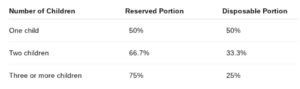
The size of each portion depends on the number of children.
Where there is one child, the reserved portion is one half of the estate. The disposable portion is therefore also one half.
Where there are two children, the reserved portion is two thirds of the estate. The disposable portion is one third.
Where there are three or more children, the reserved portion is three quarters of the estate. The disposable portion is one quarter.
It is important to understand that these fractions apply to the net estate after debts, and that French law includes specific rules for calculating the value of lifetime gifts when assessing whether the reserved portion has been satisfied. Gifts made during a lifetime can in some circumstances be brought back into the calculation, which means that the reserved heirship rules can affect not just what happens on death but also decisions made during a lifetime about transferring assets.
Who Counts As a Reserved Heir?
Under French law as it currently stands, the reserved heirs are the deceased’s children. This includes biological children, adopted children, and children from previous relationships. Grandchildren can become reserved heirs in certain circumstances, for example if a child of the deceased has predeceased them.
One child: The child is entitled to at least one half of the estate.
Two children: The two children together are entitled to at least two thirds of the estate, shared equally between them.
Three or more children: The children together are entitled to at least three quarters of the estate, shared equally between them.
Surviving spouse: A surviving spouse is not a reserved heir in the technical sense, but they do have significant rights under French law. The surviving spouse has a right to continue living in the family home for a period, and depending on the matrimonial regime under which the couple lived, may have rights over a portion of the shared assets. The surviving spouse can also benefit from the disposable portion of the estate.
Blended families: The forced heirship rules apply to all of the deceased’s children, including children from previous relationships. This can create significant tension in blended family situations where a surviving spouse and children from a prior relationship both have claims on the estate. A British expatriate who has remarried and has children from a first marriage may find that French law distributes the estate in a way that does not reflect their intentions, even if those intentions were clearly expressed in a will.
This is one of the most important planning considerations for British expatriates in France with blended families, and it is an area where specialist legal advice is essential.
Does My UK Will Still Apply?
This is one of the most common questions British expatriates ask, and the answer is more nuanced than most people expect.
A UK will is a valid legal document, and France will generally recognise a foreign will as a valid expression of the deceased’s intentions. However, a valid will and an effective will are not the same thing. A UK will that purports to leave the entire estate to a surviving spouse, bypassing children who are reserved heirs under French law, may be a valid document but may not achieve what it sets out to achieve.
French law distinguishes between the formal validity of a will, whether it was properly executed, and the substantive rules that govern how the estate is distributed. A UK will may be formally valid but may still be subject to the French forced heirship rules if those rules apply to the estate.
The position is further complicated by the fact that different assets in different countries may be treated differently. In broad terms, French law has traditionally applied its succession rules to immovable property, primarily real estate, located in France. The position for moveable assets, which includes bank accounts, investments, and personal property, is affected by the choice of law rules discussed in the Brussels IV section below.
The practical implication is that a UK will alone is unlikely to be sufficient for a British expatriate who has lived in France for many years, who owns property in France, and who has assets in both countries. The interaction between the UK will and French law needs to be reviewed by someone who understands both systems.
Brussels IV Explained
Brussels IV is the informal name for EU Succession Regulation 650/2012, which came into force across EU member states in August 2015. It is one of the most significant developments in cross-border succession law in recent years, and it has particular relevance for British expatriates living in France.
The regulation establishes which country’s law applies to a cross-border estate. In the absence of any election, Brussels IV provides that the succession is governed by the law of the country in which the deceased was habitually resident at the time of death. For a British expatriate who has been living in France for many years, this would generally mean that French law governs the succession.
However, Brussels IV also allows an individual to make an election of law, choosing the law of their nationality to govern their succession. A British national living in France can therefore elect for English law to govern their succession rather than French law.
This election can be made in a will, and it is the reason why many British expatriates in France are advised to include a Brussels IV election in their will.
What Brussels IV Does
If a valid Brussels IV election is made, English law may govern the succession rather than French law. Because English law does not contain forced heirship provisions in the same way as French law, this can provide significantly greater testamentary freedom than would otherwise be available. However, the practical effect depends on the individual’s circumstances and should always be considered alongside specialist French legal advice.
What Brussels IV Does Not Do
Brussels IV is a succession law regulation. It governs the distribution of the estate. It does not govern inheritance tax.
French inheritance tax, known as droits de succession, is determined by French tax law, not by the succession law applicable to the estate. A Brussels IV election does not remove French inheritance tax liability. If French inheritance tax applies to the assets, it will apply regardless of whether the succession is governed by English or French law.
This is one of the most commonly misunderstood aspects of Brussels IV, and it is an area where professional advice is essential. Many British expatriates assume that a Brussels IV election in their will solves the succession planning problem entirely. It addresses the forced heirship issue but leaves the tax position unchanged.
Limitations of Brussels IV
Brussels IV has limitations that are worth understanding.
It applies to moveable assets. The position for immoveable property, primarily real estate, is more complex and may be subject to additional considerations depending on the location of the property and the applicable law.
It requires a valid election, properly made. An election that is not properly documented or that is inconsistent with other provisions of the will may not achieve the intended result.
Following Brexit, the UK is no longer an EU member state. UK courts are not bound by Brussels IV. However, French courts continue to apply Brussels IV, and a Brussels IV election in a will made by a British national living in France continues to be recognised by the French legal system.
The position is one where specialist legal advice from a lawyer who understands both French and English law is essential. A Brussels IV election is a powerful planning tool, but it needs to be implemented correctly and within the context of a broader succession plan.
Does Brussels IV Remove French Inheritance Tax?
No. This distinction is important enough to warrant its own section.
French inheritance tax is levied on assets passing from a deceased person to their heirs. The rates and allowances depend on the relationship between the deceased and the heir.
Transfers between spouses and civil partners are exempt from French inheritance tax.
Transfers to children benefit from an allowance, currently 100,000 euros per child per parent, which can be applied once every fifteen years. Above that allowance, tax is levied at progressive rates.
Transfers to more distant relatives, or to individuals with no family connection, are taxed at significantly higher rates.
A Brussels IV election changes which law governs the distribution of the estate. It does not change who receives assets, and it does not change the French tax rules that apply to those transfers. If assets pass from a French-resident deceased person to their children, French inheritance tax applies to those transfers regardless of whether the succession is governed by English or French law.
Understanding the difference between succession law, which governs who receives what, and inheritance tax law, which governs what tax is paid on those transfers, is fundamental to effective succession planning in France.
UK Assets
For British expatriates with assets in both the UK and France, the treatment of UK-based assets in a French succession context is an important consideration.
UK Property
Immoveable property is generally governed by the law of the country in which it is located. UK property is therefore generally subject to English law, which means that the French forced heirship rules do not typically apply directly to it. However, the value of UK property may be relevant to the overall calculation of the estate, and specialist advice is needed to understand the interaction.
UK Bank Accounts and Investments
Moveable assets, including UK bank accounts and investment accounts, may fall within the scope of Brussels IV and may therefore be subject to the governing law elected under Brussels IV or, in the absence of an election, the law of habitual residence. The position is one where the specific circumstances matter, and generalisation is difficult.
ISAs
ISAs are a UK-specific tax wrapper. France does not recognise the ISA wrapper for tax purposes, and the assets within an ISA are treated as ordinary investments from a French tax perspective. For succession purposes, ISA assets would generally be treated as part of the moveable estate.
The Wealth Genesis | What Many British Expats in France Get Wrong About UK Income and Tax
UK Pensions
UK pensions occupy a particular position in succession planning that is worth understanding separately.
In most cases, a UK pension does not form part of the deceased’s estate in the same way as other assets. The pension fund is typically held in trust by the pension provider, and the trustees have discretion over who receives the death benefits, guided by the member’s expression of wishes through a beneficiary nomination form.
This means that a UK pension generally does not pass under a will, whether UK or French, and is not directly subject to the French forced heirship rules in the same way as estate assets.
However, this does not mean that pension planning can be ignored in the context of French succession planning.
Beneficiary nominations need to be completed, kept current, and reviewed regularly. A nomination that was made many years ago may no longer reflect the member’s current family circumstances or intentions. A nomination that names a deceased individual, a former spouse, or a beneficiary whose circumstances have changed may not achieve the intended result.
The way pension death benefits interact with French tax residency is also an area that requires specialist input. The tax treatment of pension death benefits received by a French resident can depend on a range of factors, and it is not an area where straightforward assumptions are reliable.
For British expatriates in France with significant UK pension assets, reviewing beneficiary nominations and understanding the overall position of the pension within the broader succession plan is an important step.
The Wealth Genesis | Can My UK Financial Adviser Still Advise Me If I Live in France?
Assurance Vie and Succession Planning
The Assurance Vie is one of the most commonly used financial planning vehicles in France, and it has important succession planning characteristics that make it particularly relevant for British expatriates.
An Assurance Vie allows the policyholder to designate beneficiaries within the policy itself rather than relying solely on a will. On death, the proceeds are generally paid directly to those beneficiaries and are often treated differently from assets forming part of the estate. This is one of the reasons Assurance Vie has become such an important succession planning tool in France. However, its treatment depends on the individual circumstances, the way the policy has been established, and the beneficiary wording used. It should therefore be viewed as an important planning tool rather than an automatic solution to every succession issue.
In addition, there are specific French inheritance tax provisions that apply to Assurance Vie proceeds, which can be more favourable than the standard inheritance tax rates depending on when the policy was established, the age of the policyholder at the time of contributions, and the amounts involved.
These characteristics make the Assurance Vie a useful tool in succession planning for French residents, and it is one of the reasons why it is widely used by long-term residents in France.
However, it is important not to assume that an Assurance Vie automatically solves succession planning problems.
The way beneficiary designations are structured within the policy matters significantly. A poorly drafted beneficiary clause may not achieve the intended result. The interaction between Assurance Vie proceeds and the reserved portion of the estate can be complex, particularly where the proceeds are large relative to the overall estate. And the Assurance Vie is one tool within a broader succession plan, not a substitute for it.
The Wealth Genesis | Assurance Vie vs UK Investment Accounts for British Expats in France
Common Mistakes British Expats Make
Succession planning is an area where assumptions and omissions can have significant consequences. These are some of the most common mistakes that British expatriates in France make.
Assuming a UK will overrides French law. A UK will is a valid document, but it does not automatically override French succession law. Without a Brussels IV election and careful structuring, the forced heirship rules may apply to the French estate regardless of what the will says.
Making a Brussels IV election and assuming the planning is complete. A Brussels IV election addresses the forced heirship issue but does not address French inheritance tax. Many people make the election and believe they have solved the problem, when in fact the tax planning work remains to be done.
Never reviewing beneficiary nominations. Pension beneficiary nominations and Assurance Vie beneficiary designations are not automatically updated when circumstances change. A nomination made before a divorce, before the birth of additional children, or before a change in family circumstances may no longer reflect the member’s intentions.
Relying on UK advice alone. A UK solicitor or financial adviser who does not understand French law is not in a position to advise on the interaction between the two systems. Cross-border succession planning requires input from professionals who understand both jurisdictions.
Failing to coordinate the UK will and any French will. Where both a UK will and a French will exist, they need to be drafted in a way that is consistent and complementary. A French will that revokes all prior wills, for example, may inadvertently revoke the UK will if the wording is not carefully considered.
Ignoring succession while focusing only on tax. Many British expatriates spend considerable time thinking about income tax and investment tax efficiency and relatively little time thinking about what happens on death. Succession planning deserves the same attention.
Assuming joint ownership solves the problem. Jointly owned assets pass to the surviving joint owner outside the estate in some circumstances, but the rules in France are not identical to those in England and Wales, and the position depends on how the ownership is structured and what agreements are in place.
Leaving it too late. Succession planning becomes more complicated when health is poor, when family relationships are strained, or when assets have already been distributed in ways that create complications. Planning ahead, while options are open, is significantly easier than correcting problems retrospectively.
Questions Worth Asking:
Before meeting with a specialist adviser, these questions are worth thinking through carefully. They are not exhaustive, but they provide a useful starting point for understanding where gaps in your planning may exist.
Do you have a current will, and does it include a Brussels IV election?
When was your will last reviewed, and does it reflect your current family circumstances and asset position?
Do you own property in France, and have you taken advice on how French succession law applies to it?
Do you have children from a previous relationship? If so, have you considered how the forced heirship rules interact with your intentions for your surviving spouse or partner?
Have you completed current beneficiary nominations for all UK pensions, and do those nominations reflect your current intentions?
Do you hold an Assurance Vie, and have the beneficiary designations been drafted with care and reviewed recently?
Do you understand the difference between what Brussels IV does and what it does not do?
Have you taken advice from a professional who understands both English and French law?
Have you considered the French inheritance tax position, as distinct from the succession law position?
Frequently Asked Questions
Does France have forced heirship?
Yes. French law gives children a legally protected right to a defined share of the estate, known as the réserve héréditaire. This right cannot be overridden by a will unless specific steps are taken. The proportion of the estate that must pass to children depends on the number of children involved.
Can I leave everything to my spouse in France?
Not automatically. If you have children, they are reserved heirs under French law and are entitled to a protected share of the estate. The amount your spouse can receive from the disposable portion of the estate depends on the number of children. However, a Brussels IV election may allow you to elect English law, which does not have the same forced heirship provisions. French inheritance tax between spouses is also exempt, which is a significant planning consideration.
Does my UK will still work if I live in France?
A UK will may be formally valid in France, but without a Brussels IV election it may be subject to the French forced heirship rules for assets in France. A UK will that does not include a Brussels IV election may not achieve what it sets out to achieve for a French-resident individual with French assets.
What is Brussels IV and how does it help?
Brussels IV is an EU regulation that allows individuals to elect the law of their nationality to govern their succession. A British national living in France can elect English law, which does not have the same forced heirship rules as French law. This can provide greater freedom to distribute the estate as intended. However, Brussels IV does not affect French inheritance tax, and specialist legal advice is needed to ensure the election is properly made.
Does Brussels IV remove French inheritance tax?
No. Brussels IV governs which law applies to the distribution of the estate. It does not affect French inheritance tax, which is determined by French tax law. Assets passing to children or other heirs may still be subject to French inheritance tax regardless of a Brussels IV election.
Does an Assurance Vie avoid French inheritance rules?
An Assurance Vie allows beneficiary designations to be made outside the will, and the proceeds generally pass directly to named beneficiaries rather than forming part of the estate. In most circumstances, the forced heirship rules do not apply directly to Assurance Vie proceeds. However, the position is not absolute, and the way beneficiary designations are structured matters. An Assurance Vie is a useful planning tool but not a universal solution.
What happens to my UK pension when I die in France?
UK pensions generally do not form part of the estate and are not directly subject to the French forced heirship rules. They pass according to the beneficiary nomination held by the pension trustees. However, beneficiary nominations need to be current and carefully considered, and the tax treatment of pension death benefits received by a French resident may require specialist advice.
Do I need both a UK will and a French will?
In many cases, yes, but the two wills need to be carefully coordinated to avoid unintended consequences. A French will that revokes all prior wills, for example, may inadvertently revoke the UK will. Specialist legal advice from a professional who understands both systems is important.
What if I own property in both countries?
UK property is generally subject to English law, which means the French forced heirship rules do not typically apply directly to it. French property is more likely to be subject to French succession rules. The interaction between the two positions, and the overall tax and succession planning picture, requires coordinated advice across both jurisdictions.
What is the French inheritance tax allowance for children?
Under current French law, each child benefits from an allowance of 100,000 euros per parent, which can be used once every fifteen years. Above that allowance, inheritance tax is levied at progressive rates. Lifetime gifts can use the same allowance, which is one reason why planned lifetime transfers are sometimes considered as part of a broader succession strategy.
What is the matrimonial regime and why does it matter?
The matrimonial regime is the legal framework governing the ownership and management of assets between spouses. In France, the default regime is the communauté réduite aux acquêts, under which assets acquired during the marriage are jointly owned. The matrimonial regime affects what forms part of the estate on death and what passes automatically to the surviving spouse. British expatriates who married in the UK may be subject to a different matrimonial regime, and the position requires specialist advice.
Can children challenge a will in France?
Yes. Reserved heirs who have not received their protected share of the estate have a legal right to bring a claim to recover it. This right is enforceable through the French courts and cannot be waived by the deceased in a will, except in specific and limited circumstances. Planning ahead to ensure that the reserved portion is properly addressed is considerably more straightforward than dealing with a legal challenge after death.
What happens if I die in France without a will?
Without a will, French intestacy rules apply to assets within France. Under those rules, the estate passes according to a defined hierarchy of heirs. The surviving spouse and children share the estate in proportions determined by French law, which may not reflect the deceased’s wishes. Making a will, including a Brussels IV election where appropriate, is an important step for any British expatriate in France.
About The Wealth Genesis
At The Wealth Genesis, we work with British expatriates whose financial affairs span both the UK and France.
Many of our clients have UK pensions, investment portfolios, ISAs, and property interests alongside French tax residency. Succession planning is one of the areas where the cross-border dimension matters most, and where the consequences of leaving things unaddressed can be most significant.
We work alongside French tax and legal specialists where appropriate, and our advice is provided on a transparent, flat fee basis with no product commissions.
If you have questions about how your current financial arrangements interact with French succession law, or if you would like to discuss your position more broadly, we are happy to have that initial conversation at no charge and with no obligation.
Next Steps
Succession planning in France is not something that can be addressed with a UK will alone, and it is not an area where leaving things until later is without risk. Family circumstances change, assets move between countries, and the interaction between English law and French law creates planning considerations that deserve careful attention.
If you are a British expatriate living in France and you are not confident that your succession arrangements have been reviewed with both jurisdictions in mind, we are happy to discuss your situation.
We offer an initial consultation at no charge and with no obligation. Use the contact form below to get in touch, or visit our contact page to arrange a call at a time that suits you.